How Custom MVP Development Can Reduce Product Risk Before a Major Investment
- devoptiv082
- 2 days ago
- 4 min read

You have an idea. Maybe you've even sketched it out and talked to a few friends about it. But here's the hard truth: most product ideas fail not because the idea was bad, but because founders spend too much money building the wrong thing before they find out if people actually want it.
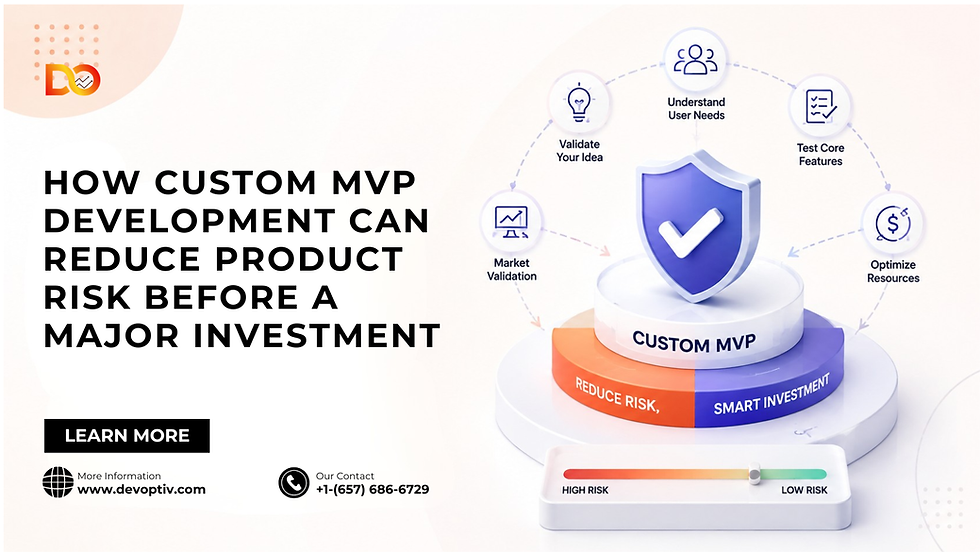
This is exactly the problem custom mvp development solves. It lets you test your idea with real users before you commit serious time and money. Let's look at why that matters and how it protects you.
What "Product Risk" Actually Means
Product risk is simply the chance that you build something nobody wants. It's the biggest reason startups fail, not bad marketing, not bad timing, just building the wrong product. It shows up in a few ways:
Market risk Does anyone really have the problem you think they have?
Solution risk: Does your specific solution actually solve it well?
Usability risk Will people understand how to use what you built?
Business model risk: Will people pay for it, and will the numbers work?
Every one of these is expensive to discover after you've built a full product. It's cheap to discover before.
Why Jumping Straight to a Full Build Is Risky
Say you skip validation and go straight into building a polished, full-featured product. You hire a team, spend months building, and launch with a big push.
Then the feedback comes in and a lot of it isn't good. Users don't get your onboarding. The feature you thought was your differentiator turns out to be something nobody cares about. You built for the wrong audience.
Now you're stuck. The budget's spent, investors are asking hard questions, and you have to rebuild large chunks of the product with less money and less time. This is the trap a custom mvp development approach helps you avoid.
What an MVP Actually Does for You
An MVP isn't a cheap, broken version of your idea. It's a focused version built with just enough to test your riskiest assumptions with real users. Think of it as an experiment, not a smaller product. You're trying to answer one question: will people actually use this to solve their problem?
A good MVP gives you:
Real feedback from real users, not guesses from your own team
Usage data showing what people actually do, not what they say they'll do
A much smaller financial commitment, so mistakes cost less
Speed you can launch in weeks, not months
Room to pivot before you've over-invested in one direction
This is exactly what a team offering custom mvp development services helps you do: build something focused and fast, designed to answer your riskiest questions before you build "the whole thing."
How an MVP Reduces Risk
It tests the problem before the solution. You get in front of real users early to see if they actually care about the problem you're solving, instead of assuming.
It costs a fraction of a full build. You're not paying for a polished dashboard or a dozen unvalidated integrations. You're paying to answer one question: does this work?
It shows you what to cut, not just what to add. Founders almost always start with too many features in mind. Real users quickly show you which ones actually matter.
It builds credibility with investors. A working MVP with real user data is far more convincing than a slide deck and a dream.
It keeps you objective. When you've only invested a small amount, it's much easier to pivot based on what users tell you instead of defending a huge sunk cost.
A Quick Example
Two founders build the same idea: an app to help restaurants manage online orders.
Founder A skips testing, spends eight months building a full platform with inventory tools, staff scheduling, and analytics. They launch and restaurants churn within two weeks. Turns out owners just wanted a simple way to stop losing orders during rush hour.
Founder B builds a lean MVP in six weeks that does one thing well: pulls orders from multiple platforms into one screen. They test it with ten restaurants, get real feedback fast, and know exactly what to build next.
Same idea, very different outcomes because one founder tested first.
Common MVP Mistakes to Avoid
Too many features. If your "MVP" has ten features, it's not testing anything specific.
Skipping real users. Feedback from your own team or friends won't tell you much.
Treating it as disposable. A good MVP should be a foundation you build on, not something you throw away.
No clear success metric. Decide upfront what "it worked" actually looks like signups, retention, repeat use before you launch.
A Simple Way to Approach It
Write down your riskiest assumption, the one thing that could kill the whole idea if it's false.
Build the smallest possible test for that assumption.
Get it in front of real users fast.
Track what people actually do, not just what they say.
Use what you learn to decide your next move.
This is exactly the process behind good custom mvp development services helping you learn as much as possible, as cheaply and quickly as possible, before you commit to a bigger investment.
Conclusion
Building a product without testing it first is one of the most expensive gambles a founder can make. A custom MVP gives you a faster, cheaper, and more reliable way to find out if your idea works before you put real money on the line.
If you're getting ready to test your idea the right way, Devoptiv helps founders build focused, well-built MVPs designed to answer the questions that matter most before a major investment so you can move forward with confidence, not guesswork.


Comments